

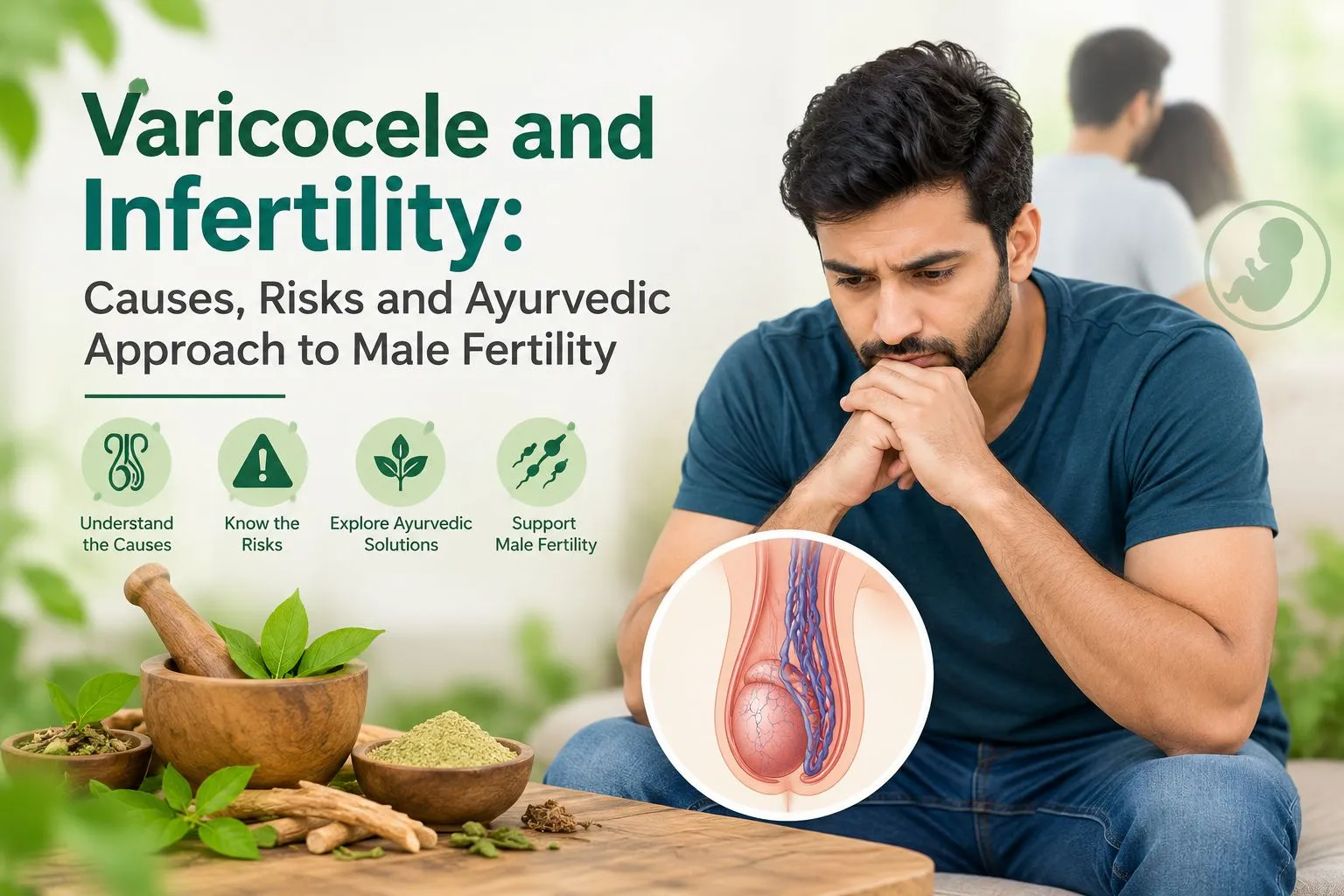
Varicocele and Infertility: Causes, Risks and Ayurvedic Approach to Male Fertility
Varicocele and Infertility: Causes, Risks and Ayurvedic Approach to Male Fertility
Varicocele and infertility are closely linked, and many men learn about the condition only after months of trying for a baby without success. A varicocele is an enlargement of the veins that drain the testicle. It is found in about 15 out of every 100 men, but in roughly 35 out of every 100 men who have primary infertility. At Shiksha Ayurveda, couples often ask us one question: can Ayurveda help? This guide explains how varicocele affects sperm, how it is diagnosed, what Ayurveda says about it, and what a safe and realistic care plan looks like.
What is a varicocele?
A varicocele is a swelling of the pampiniform plexus, the network of veins that carries blood away from the testicle. It is similar to varicose veins in the legs. Valves inside these veins stop working well, so blood pools instead of flowing upward. About 85 to 90 percent of cases are on the left side, because of the way the left testicular vein joins the kidney vein.
Many men have no symptoms and find out only during a fertility check. When symptoms appear, they can include:
- A dull ache or heaviness in the scrotum, often worse after standing for long
- Swollen or twisted veins you can see or feel
- One testicle looking smaller than the other
- Difficulty conceiving after 12 months of regular, unprotected intercourse
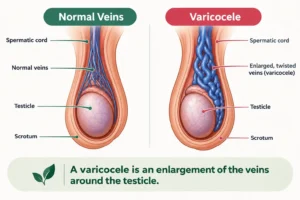
Varicocele grades
| Grade | What the doctor finds |
|---|---|
| Subclinical | Seen only on a Doppler ultrasound; not felt by hand |
| Grade I (small) | Felt only when you bear down and hold your breath |
| Grade II (moderate) | Felt while standing at rest, but not visible |
| Grade III (large) | Visible through the skin and easy to feel |
Can varicocele cause infertility?
It can, but not in every man. Many men with a varicocele father children without any treatment. Still, the numbers show a clear pattern. A medical review reports that varicocele is present in about 15 percent of the general male population, about 35 percent of men with primary infertility, and up to 80 percent of men with secondary infertility, meaning men who have fathered a child before but now struggle to conceive. The same review notes that a large World Health Organization study found varicocele in about one in four men with abnormal semen results, compared with about one in eight men with normal results.
Researchers still debate exactly how a varicocele harms fertility, and not every man is affected the same way. That is why a proper semen analysis matters more than the varicocele grade alone.
How varicocele affects sperm
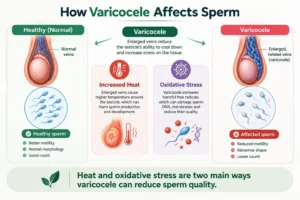
- Heat: Pooled blood warms the scrotum. Sperm are made best a few degrees below body temperature, so extra heat can reduce production.
- Oxidative stress: Slow blood flow can raise harmful reactive oxygen molecules, which damage sperm membranes and DNA.
- Lower oxygen supply: Poor drainage can reduce the oxygen and nutrients that reach the testicle.
- Hormonal effects: In some men, long-standing varicocele is linked to lower testicular function over time.
The usual result on a semen report is a lower sperm count, weaker movement (motility) and a higher share of abnormally shaped sperm.
How is varicocele diagnosed?
Diagnosis usually has four parts:
- Physical examination by a doctor, standing and lying down.
- Scrotal Doppler ultrasound to confirm the veins and measure testicular size.
- Semen analysis, reviewed against the World Health Organization reference values, which list lower limits such as a sperm concentration of 16 million per millilitre, total motility of 42 percent and normal shape of 4 percent.
- Blood tests such as FSH, LH and testosterone, and sometimes a sperm DNA fragmentation test, when your doctor advises them.
Sperm take roughly 70 to 90 days to develop, so any change from treatment shows on a semen report only after about three months. Plan a repeat test at that point, not sooner.
Ayurvedic view of varicocele and male infertility
Classical Ayurveda does not use the word varicocele. Many Ayurvedic physicians correlate it with Siraja Granthi, a knotted swelling of the veins. In male infertility, texts describe weak or depleted Shukra dhatu (reproductive tissue), often called Alpa Shukra or Kshina Shukra.
From the Ayurvedic view, several factors may disturb Shukra dhatu:
- Aggravated Vata, which affects circulation and movement in the veins
- Aggravated Pitta, which adds excess heat and burning to the blood (Rakta)
- Weak digestion (Agni), so tissues are poorly nourished
- Long-standing stress, poor sleep, spicy and fried food, and holding back natural urges
- Low Ojas, the vital essence linked to immunity and fertility
These are traditional concepts, not modern anatomical diagnoses. A responsible Ayurvedic plan uses them to personalise care, while still relying on ultrasound and semen reports to measure progress.

Ayurvedic treatment for varicocele: what a physician may plan (H2)
There is no single Ayurvedic formula for every man. At Shiksha Ayurveda, care starts with a full consultation, including your prakriti (constitution), current imbalance (vikriti), digestion, sleep, stress and your modern reports. The plan may then combine the elements below.
Herbs traditionally used for male reproductive health
| Herb | Traditional use | What the evidence says |
|---|---|---|
| Ashwagandha (Withania somnifera) | Rasayana for stress, strength and fertility | A 2018 systematic review found better semen volume, count and motility, mostly from small studies without a control group; larger trials are still needed |
| Shilajit | Rejuvenation and vitality | Limited human data; use only purified, lab-tested products because poor-quality resin can carry heavy metals |
| Gokshura (Tribulus terrestris) | Urinary and reproductive health | Results are mixed |
| Safed musli (Chlorophytum borivilianum) | Vajikarana (sexual and reproductive tonic) | Mostly animal research |
| Kapikacchu (Mucuna pruriens) | Vajikarana, stress-related infertility | Small studies; it contains L-dopa, so check with your doctor if you take medicines for Parkinson’s disease or mood |
| Amalaki (Emblica officinalis) | Antioxidant, digestive and rejuvenating | Rich in vitamin C; supportive rather than a treatment for varicocele |
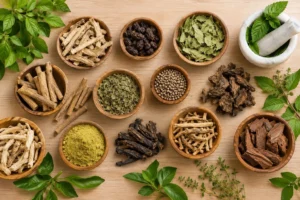 Safety note: Do not start these herbs on your own. Ashwagandha can interact with thyroid, sedative and diabetes medicines. Dose, form and duration should be set by a registered Ayurvedic physician who knows your full history.
Panchakarma and supportive therapies
Panchakarma is the Ayurvedic system of body cleansing and rebalancing. For male fertility concerns, a physician may consider:
- Virechana (medicated purgation) when Pitta and heat are prominent
- Basti (medicated enema therapy) for Vata imbalance, a therapy often described as central to reproductive health
- Abhyanga (oil massage) and Shirodhara to ease stress and improve sleep
These therapies suit some men and not others. They are not advised during acute illness or severe weakness, and they must always be done under qualified supervision.
What Ayurveda can and cannot do
- It may support: sperm quality markers, stress levels, digestion, sleep, energy and general reproductive health
- It cannot promise: to physically reverse a moderate or large varicocele, or to guarantee a pregnancy
- It should not replace: surgery or embolisation when your urologist advises it
When should you see a urologist about surgery?
Seek a urologist’s opinion if you have a palpable varicocele and any of the following:
- You and your partner have been trying to conceive for 12 months or more
- Your semen analysis is abnormal on repeat testing
- You have pain, or one testicle is shrinking
- Your teenage son has a varicocele with a visibly smaller testicle
The main procedures are microsurgical varicocelectomy and radiological embolisation. If your semen analysis is normal and you have no symptoms, doctors often advise regular follow-up instead of an operation. Your partner should also be assessed, because infertility often has more than one cause.
Choosing surgery does not rule out Ayurveda. Many men use Ayurvedic diet, herbs and lifestyle care alongside modern treatment. Tell both doctors about every medicine you take.
Ayurvedic diet for sperm health
| Pathya (helpful) | Apathya (best limited) |
|---|---|
| Small amounts of cow ghee | Very spicy, sour and fried food |
| Soaked almonds, dates, figs and raisins | Excess salt and packaged snacks |
| Warm milk and fresh buttermilk | Alcohol, tobacco and energy drinks |
| Pomegranate, amla, seasonal fruit | Stale, reheated or very cold food |
| Moong dal, leafy greens, pumpkin seeds | Skipping meals or eating late at night |
| Coconut water and plenty of clean water | Processed meat and sugary drinks |
Modern research also links diets rich in fruits, vegetables, nuts, whole grains and fish to better semen quality, so the two approaches agree on the basics.
Yoga and lifestyle tips for men with varicocele
- Gentle yoga: Viparita Karani (legs up the wall), Baddha Konasana and Setu Bandhasana, learned from a trained teacher
- Breathing: Anulom Vilom and Bhramari for 10 minutes a day to lower stress
- Keep the scrotum cool: Avoid hot baths, saunas, laptops on the lap and very tight underwear
- Limit heavy straining: Avoid heavy weight lifting with breath-holding, and long periods of cycling or sitting
- Sleep and weight: Aim for 7 to 8 hours of sleep and a healthy body weight
- Quit smoking and limit alcohol, both of which are linked to poorer sperm quality
How Shiksha Ayurveda approaches male infertility
At Shiksha Ayurveda, our approach to varicocele-related infertility follows four steps:
- Detailed consultation and review of your semen analysis, ultrasound and past treatment
- Personalised plan covering medicines, diet, daily routine and, where suitable, Panchakarma
- Follow-up with a repeat semen analysis after about three months
- Coordinated care, with a referral to a urologist or fertility specialist when your case needs it